
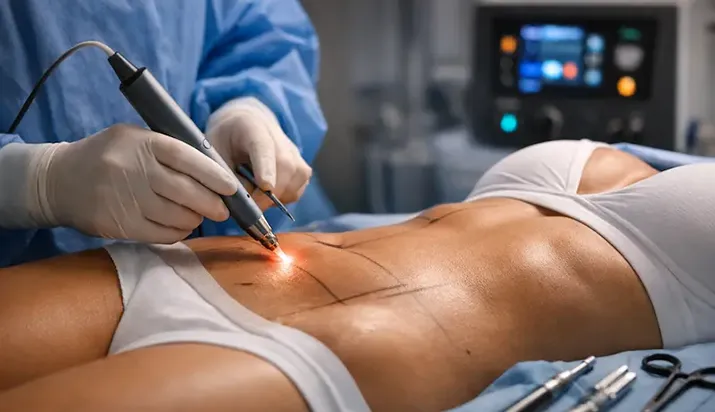
J-Plasma Skin Tightening — Key Facts
- What it is: A subdermal skin tightening technology that uses helium gas and radiofrequency (RF) energy to contract loose skin during or after liposuction.
- How it works: A thin device is inserted beneath the skin through the same small incisions used for liposuction. The helium-RF combination heats the deep tissue to contract collagen fibers while simultaneously cooling the area to prevent burns.
- Procedure time: 30–60 minutes when combined with liposuction (added to the liposuction operating time).
- Recovery: Most patients return to light daily activities within 3–5 days. Final results develop over 3–9 months as new collagen forms.
- Best for: Patients with mild to moderate skin laxity who want tighter skin after fat removal but do not want or need a surgical lift (tummy tuck, arm lift).
- Performed by: Dr. Emre Özenalp, board-certified plastic surgeon, Istanbul, Turkey.
What Is J-Plasma Skin Tightening?
J-Plasma is a minimally invasive skin tightening technology used by plastic surgeons to contract loose or lax skin, most commonly during a liposuction procedure. The device delivers a controlled stream of cold helium plasma combined with radiofrequency energy directly beneath the skin surface, causing the collagen network in the deeper tissue layers to shrink immediately on contact.
The result is a tighter, smoother skin envelope over the area where fat has been removed — without the long incisions, visible scars, or extended recovery associated with surgical excision procedures such as a tummy tuck or arm lift.
In my practice, I use J-Plasma primarily as an add-on to liposuction for patients who fall into a specific category: they have enough skin laxity that standard liposuction alone may leave loose skin behind, but not so much excess skin that a surgical lift is necessary. This is a common profile among patients in their mid-30s to 50s, patients who have lost a moderate amount of weight, and women whose skin elasticity has changed after pregnancy. Rather than choosing between liposuction with the risk of loose skin or a more invasive lift procedure, J-Plasma gives these patients a middle option with meaningful skin contraction and minimal additional downtime.
J-Plasma is not a liposuction technique — it does not remove fat. It is a skin tightening technology applied through the same tiny incisions used during liposuction, typically in the same surgical session. This distinction matters because it means the procedure adds skin contraction to the body contouring results of liposuction without requiring a separate operation or additional scarring.
How Does J-Plasma Work During Liposuction?
J-Plasma combines two energy sources — cold helium gas and radiofrequency (RF) — to create a precise form of plasma energy. When this energy is applied to the underside of the skin, it generates controlled heat that causes the existing collagen fibers to contract and shorten. At the same time, the helium gas cools the surrounding tissue almost instantly, which protects the skin surface and deeper structures from thermal damage. This dual mechanism — targeted heating followed by rapid cooling — is what allows J-Plasma to produce significant tissue contraction without the burns or tissue injury associated with older thermal devices.
When I combine J-Plasma with liposuction, the procedure follows a specific sequence:
- Step 1 — Liposuction is performed first. Using the chosen liposuction technique (VASER, traditional, or power-assisted depending on the patient’s needs), I remove the targeted fat deposits through small incisions, typically 3–4 mm in length. This step sculpts and contours the treatment area.
- Step 2 — J-Plasma is applied through the same incisions. Once the fat removal is complete, the J-Plasma handpiece is inserted beneath the skin through the existing liposuction incisions. No new cuts are needed. The device is moved across the underside of the skin in a systematic pattern, delivering helium-RF energy to contract the tissue evenly across the treated area.
- Step 3 — Immediate contraction occurs on the table. The skin tightening effect is partially visible during surgery — the tissue visibly contracts as the energy is applied. However, this initial contraction represents only part of the final result.
- Step 4 — Collagen remodeling continues for months. Over the following 3 to 9 months, the body produces new collagen in response to the controlled thermal stimulus. This secondary tightening phase is what produces the final result, and it is why patients are advised that their outcome will continue to improve for several months after surgery.
The entire J-Plasma application typically adds 30 to 60 minutes to the liposuction procedure, depending on how many areas are being treated. Because both steps use the same incisions and are performed under the same anesthesia, there is no additional scarring and no need for a second surgery or recovery period.
Who Is a Good Candidate for Liposuction with J-Plasma?
Not every liposuction patient needs J-Plasma, and not every patient with loose skin is a candidate for it. The decision depends on the degree of skin laxity, the treatment area, the patient’s age, and how much fat is being removed. During the consultation, I assess these factors to determine which of three approaches will produce the best outcome.
Liposuction alone — when skin elasticity is sufficient
Patients with firm, elastic skin and good underlying muscle tone typically do not need J-Plasma. After fat is removed, their skin retracts naturally over the following weeks and months. This is most common in younger patients — generally under 35 — who are close to their ideal weight and have localized fat deposits resistant to diet and exercise. For these patients, adding J-Plasma would be unnecessary cost without meaningful additional benefit.
Liposuction with J-Plasma — the middle ground
This is the patient profile where J-Plasma delivers its greatest value. These patients have mild to moderate skin laxity — enough that liposuction alone would likely leave some visible looseness, but not so much that a surgical excision is warranted. Common characteristics include:
- Age typically between 35 and 55, though skin quality matters more than age alone.
- Skin that has lost some elasticity due to aging, moderate weight fluctuation, or pregnancy but still has reasonable underlying tone.
- Treatment areas where surgical lifts would create disproportionately long scars relative to the problem — for example, the upper arms, inner thighs, or the area above the belly button where a mini tummy tuck would not reach.
- Patients who have been told they need a tummy tuck but are not willing to accept the longer incision, longer recovery, and more visible scarring that come with it, and who understand that J-Plasma will provide a moderate level of tightening rather than the dramatic skin removal of a full abdominoplasty.
I discuss realistic expectations openly with these patients. J-Plasma produces genuine, measurable skin contraction, but it does not replicate the results of a surgical lift. A patient with 5–8 centimetres of loose abdominal skin may see meaningful improvement. A patient with 15 centimetres of hanging skin after major weight loss will not — that patient needs a tummy tuck.
Surgical lift — when skin excess is too significant
When there is substantial excess skin — after massive weight loss, after multiple pregnancies with significant diastasis recti, or in patients with very poor skin elasticity — no amount of subdermal energy will produce an acceptable result. These patients are better served by a surgical excision procedure: a tummy tuck for the abdomen, an arm lift for the upper arms, or a thigh lift for the legs. I would rather redirect a patient to the procedure that will actually solve their problem than offer J-Plasma where it will underdeliver.
This three-tier assessment is something I walk through with every patient during their consultation. Some patients arrive requesting J-Plasma specifically because they have seen it on social media, and it is my responsibility to determine whether it is genuinely the right tool for their anatomy — not just the one they read about online.
What Areas Can Be Treated with J-Plasma?
J-Plasma can be applied to nearly any area of the body where skin laxity is a concern, either alongside liposuction or as a standalone treatment. Below are the areas I most commonly treat with J-Plasma in combination with liposuction, and what patients can typically expect for each.
Abdomen and stomach
The abdomen is the single most requested area for J-Plasma skin tightening during liposuction. This is especially relevant for patients undergoing 360 liposuction who have moderate skin laxity around the midsection — often women after one or two pregnancies, or patients who have lost 15–25 kilograms and have some residual looseness above and below the belly button but not enough to justify a full tummy tuck. J-Plasma applied across the abdominal skin during lipo helps the skin contract over the newly sculpted contour rather than hanging loosely over it.
Upper arms
The upper arms are one of the areas where J-Plasma can make the biggest visible difference. Arm skin is thin and has limited elasticity, which means that liposuction alone frequently leaves noticeable looseness — particularly on the inner arm between the elbow and armpit. For patients who want slimmer arms but want to avoid the long scar that runs from armpit to elbow in a traditional arm lift, J-Plasma provides a meaningful degree of tightening with no visible scarring beyond the small liposuction incision points.
Inner thighs and legs
The inner thigh presents a similar challenge to the arms: the skin is thin, prone to laxity, and does not retract as predictably after fat removal as thicker-skinned areas like the flanks. J-Plasma applied during inner thigh liposuction helps reduce the risk of post-operative looseness in this area. For patients with more significant inner thigh laxity, a surgical thigh lift may still be the better option, and I assess this during the consultation.
Neck and jawline
Submental (under-chin) liposuction combined with J-Plasma is an effective approach for patients who have early jowling or a soft, undefined jawline with mild skin laxity. The neck skin responds well to J-Plasma because it is relatively thin and the treatment area is small, allowing precise energy delivery. For patients with more advanced neck aging — deep neck bands, significant platysmal banding, or heavy jowls — a surgical neck lift will produce better results.
Back, bra line, and flanks
Fat deposits along the back, bra line, and flanks are common liposuction targets, particularly in 360 liposuction procedures. The skin in these areas generally has better elasticity than the arms or inner thighs, so J-Plasma is not always necessary here. However, for patients with reduced skin quality — particularly after weight loss — adding J-Plasma to back and flank liposuction helps ensure a smooth contour without skin irregularities or residual looseness.
J-Plasma vs Other Skin Tightening Technologies
Patients researching skin tightening during liposuction will encounter several different technologies, each with different energy sources, mechanisms, and trade-offs. The table below provides a direct comparison of the most commonly used options. I have included this because many patients come to their consultation having read about multiple devices without a clear understanding of how they differ or which one is appropriate for their situation.
| J-Plasma | BodyTite | VASER | Laser (SmartLipo) | External RF | |
|---|---|---|---|---|---|
| Energy Source | Helium gas + radiofrequency | Bipolar radiofrequency | Ultrasound | Laser (1064 nm or 1470 nm) | Radiofrequency (surface) |
| Primary Function | Skin tightening (subdermal) | Skin tightening + fat coagulation | Fat emulsification + mild tightening | Fat melting + mild tightening | Skin tightening (non-invasive) |
| Applied During Liposuction? | Yes — same session, same incisions | Yes — same session, same incisions | Yes — it is a liposuction technique | Yes — it is a liposuction technique | No — performed separately, post-op |
| Skin Tightening Mechanism | Direct collagen contraction via plasma energy + cooling | Direct collagen contraction via bipolar RF heating | Secondary tightening from ultrasound thermal effect | Secondary tightening from laser thermal effect | Surface heating stimulates collagen over multiple sessions |
| Degree of Skin Tightening | Significant — primary purpose | Significant — comparable | Mild to moderate — secondary benefit | Mild to moderate — secondary benefit | Mild — requires multiple sessions |
| Recovery | Similar to liposuction alone | Similar, slightly more swelling | Standard liposuction recovery | Standard liposuction recovery | No downtime per session |
| Best Suited For | Dedicated skin contraction alongside lipo | Dedicated skin contraction alongside lipo | Fat removal in fibrous areas with mild laxity | Small areas needing fat removal + mild tightening | Very mild laxity, no surgery desired |
A few points that are important to understand when reading this comparison:
VASER and SmartLipo are primarily liposuction technologies — they remove fat, and any skin tightening they produce is a secondary thermal effect, not their main purpose. J-Plasma and BodyTite are the opposite — they are dedicated skin tightening devices that do not remove fat and are used alongside a separate liposuction step.
This means VASER and J-Plasma are not competing alternatives. In fact, I frequently combine them: VASER to emulsify and remove fat efficiently, followed by J-Plasma through the same incisions to contract the skin. The choice is not “one or the other” — it is whether the patient’s skin quality requires a dedicated tightening step on top of their liposuction, or whether the secondary tightening effect from the liposuction technique alone will be sufficient.
External (non-invasive) RF devices such as surface radiofrequency treatments deliver energy from outside the body. Because the energy must pass through the skin surface to reach deeper tissue, the intensity is limited to avoid burning the skin. This makes these devices safe but significantly less effective for skin contraction compared to subdermal devices like J-Plasma, which deliver energy directly to the tissue that needs to contract. External RF is most appropriate for patients with very mild skin laxity who want to avoid any surgical procedure entirely.
J-Plasma Results and Recovery Timeline
One of the most common questions I receive from patients considering J-Plasma is how long it takes to see results and what the recovery looks like. Because J-Plasma is almost always performed alongside liposuction, the recovery is largely governed by the liposuction itself — J-Plasma adds minimal additional downtime. However, the results timeline has two distinct phases that patients should understand before surgery.
Immediate results vs long-term results
J-Plasma produces a visible degree of skin contraction during the procedure itself — the tightening is partially apparent on the operating table. However, this immediate contraction is not the final result. The full outcome develops over the following months as the body responds to the controlled thermal stimulus by producing new collagen. Patients who judge their result at two weeks post-op are seeing the early stage, not the finished outcome.
Week-by-week recovery
Days 1–3: Rest and compression
The treated areas will be swollen, tender, and bruised — this is a normal response to both liposuction and J-Plasma. You will wear a compression garment continuously from the day of surgery. Most patients manage discomfort with prescribed medication during this period. Light movement around the house is encouraged to support circulation, but physical activity should be avoided.
Days 4–7: Return to light activity
Swelling and bruising begin to decrease. Most patients feel well enough to return to desk work or light daily routines by day 5–7, depending on how many areas were treated. The compression garment should be worn as directed — typically 23 hours per day during this phase. Some patients notice the early skin tightening effect already becoming visible as the initial swelling starts to settle.
Weeks 2–4: Gradual improvement
Bruising fades significantly during this period. Swelling continues to reduce but will not be fully resolved — particularly in the abdomen, which tends to hold swelling longer than other areas. You can resume moderate exercise (walking, light gym work) around week 3–4, based on my post-operative guidance. The compression garment is typically worn for a total of 4–6 weeks.
Months 1–3: Collagen remodeling begins
This is when the secondary tightening phase becomes noticeable. As the body produces new collagen in response to the J-Plasma energy, the skin continues to firm and tighten beyond the initial contraction seen during surgery. Patients often report that their results look better at month 3 than at month 1 — this is the collagen remodeling effect at work.
Months 3–9: Final results
The skin continues to improve gradually until approximately 9 months post-procedure, at which point the collagen remodeling process is essentially complete. The final result at 9 months represents the full extent of the skin tightening achieved by J-Plasma. What the patient sees at 9 months is what they can expect to maintain long-term, provided their weight remains stable.
How long do J-Plasma results last?
The collagen contraction and new collagen produced by J-Plasma are permanent structural changes in the tissue. The fat cells removed during liposuction do not regenerate. In this sense, the results are long-lasting — many patients maintain their outcome for 7 years or more.
However, J-Plasma does not stop the natural aging process. Skin will continue to lose elasticity over time, and significant weight gain after the procedure can stretch the skin and diminish the result. Maintaining a stable weight through consistent diet and exercise is the single most important factor in preserving the outcome long-term.
J-Plasma Skin Tightening Cost in Turkey
The cost of J-Plasma skin tightening depends on several factors: how many body areas are being treated, whether it is combined with liposuction (which it almost always is), the liposuction technique used, and the extent of the procedure. Because J-Plasma is performed as an add-on during liposuction surgery rather than as a standalone operation, it is typically priced as part of a combined liposuction package rather than as a separate fee.
In Turkey, the cost of liposuction with J-Plasma skin tightening is significantly lower than in Western Europe, the UK, the United States, or Australia — typically 50–70% less for an equivalent procedure — without any compromise in surgical quality, hospital standards, or post-operative care. This cost difference is driven by lower operational expenses in Turkey, not by differences in surgeon qualification, equipment, or safety protocols.
The table below gives a general comparison of what patients can expect to pay for liposuction combined with skin tightening across different countries. Exact pricing varies by individual case and is confirmed after a personal consultation with Dr. Emre Özenalp.
| Country | Liposuction with J-Plasma (€) |
|---|---|
| Turkey | 3,000 – 5,500 |
| United Kingdom | 8,000 – 14,000 |
| United States | 8,500 – 16,000 |
| Australia | 7,500 – 13,500 |
| Canada | 7,500 – 15,000 |
| Germany / Netherlands | 5,500 – 12,000 |
What is included in the price?
When you have liposuction with J-Plasma performed by Dr. Emre Özenalp in Istanbul, the quoted price is an all-inclusive package. There are no hidden fees or unexpected charges after your consultation. The package includes:
- The surgical procedure (liposuction + J-Plasma) performed at a JCI-accredited university hospital
- General anesthesia and all operating room costs
- 1 night of hospitalization with post-operative monitoring
- 6 nights of accommodation in a luxury hotel
- All pre-operative tests and laboratory work
- Post-operative medications, compression garments, and supplies
- VIP airport transfers and all transportation between hotel, hospital, and clinic
- Pre- and post-operative support from a multilingual patient coordinato
- Follow-up consultations during your stay and remote follow-up after you return home
This all-inclusive structure is particularly important for international patients because it eliminates the uncertainty of separate billing for anesthesia, hospital fees, medications, and follow-up visits that is common in the UK, US, and Australian pricing models — where the advertised surgical fee often represents only a portion of the total cost.
Frequently Asked Questions About J-Plasma
Is J-Plasma worth it?
For patients who fall into the right candidacy profile — mild to moderate skin laxity, not enough excess skin to require a surgical lift — J-Plasma delivers meaningful, visible skin tightening with minimal additional recovery beyond what liposuction alone requires. The value is strongest when J-Plasma prevents the need for a more invasive and expensive procedure such as a tummy tuck or arm lift. For patients with very good skin elasticity who would retract well without it, or for patients with severe skin excess who need a surgical lift regardless, J-Plasma would not be the right investment. This is why the consultation assessment matters — the goal is to determine whether J-Plasma will make a genuine difference for your specific anatomy.
Can J-Plasma be done without liposuction?
Yes. J-Plasma can be performed as a standalone skin tightening procedure without liposuction, although this is less common. Standalone J-Plasma is most often used on the neck and jawline for patients who have mild skin laxity but no excess fat to remove, or on areas where a patient has previously had liposuction and developed some looseness over time. In most body contouring cases, however, J-Plasma is combined with liposuction because patients typically need both fat removal and skin tightening to achieve their desired result.
Is J-Plasma safe?
J-Plasma has a well-established safety profile when performed by an experienced, board-certified plastic surgeon. The helium gas cooling mechanism is specifically designed to protect surrounding tissue from thermal injury — this is the key engineering feature that distinguishes it from older thermal devices. As with any surgical procedure, risks include bruising, swelling, temporary numbness, and in rare cases, minor skin irregularities. Serious complications are uncommon. The most important safety factor is not the device itself but the experience of the surgeon using it — proper technique, appropriate energy settings, and correct patient selection are what determine both safety and outcome.
Does J-Plasma hurt?
J-Plasma is performed under general anesthesia when combined with liposuction, so you will not feel anything during the procedure. In the days following surgery, the discomfort is primarily from the liposuction rather than the J-Plasma application. Most patients describe the sensation as tightness and tenderness in the treated areas, similar to the feeling after an intense workout. This is managed effectively with prescribed pain medication and typically subsides within the first week.
How long does it take to see J-Plasma results?
The initial skin contraction is partially visible within the first 2–3 weeks as post-operative swelling begins to settle. However, the full result develops over 3 to 9 months as the body produces new collagen in response to the thermal treatment. Most patients notice a significant improvement between months 2 and 4, with the final outcome visible at approximately 9 months. Judging the result too early — particularly in the first month when swelling is still present — does not reflect the final outcome.
Does J-Plasma help with cellulite?
J-Plasma is not designed to treat cellulite. Cellulite is caused by fibrous bands pulling the skin surface downward, creating dimpling — this is a structural issue in the connective tissue, not a skin laxity problem. J-Plasma contracts the skin envelope but does not address the underlying fibrous septae responsible for cellulite. If cellulite is a primary concern, other treatment approaches would be more appropriate, and I would discuss these during your consultation.
Is J-Plasma the same as Renuvion?
J-Plasma and Renuvion refer to the same core technology — a device that combines helium gas with radiofrequency energy to tighten skin beneath the surface. Renuvion is the brand name registered by the manufacturer Apyx Medical, while J-Plasma is the term more widely used by both surgeons and patients to describe the procedure. When researching skin tightening options, you may see either name used interchangeably. The clinical mechanism, results, and recovery are identical regardless of which term is used.
Can J-Plasma replace a tummy tuck?
No. J-Plasma and a tummy tuck are designed for different degrees of the same problem. J-Plasma contracts existing skin by stimulating collagen — it does not remove skin or repair separated abdominal muscles (diastasis recti). A tummy tuck physically excises excess skin, removes fat, and tightens the underlying muscle wall. For patients with significant skin excess after major weight loss or multiple pregnancies, a tummy tuck will produce a dramatically better result than J-Plasma. Where J-Plasma is valuable is for patients who have moderate laxity but want to avoid the longer incision, longer recovery, and more visible scarring of an abdominoplasty. During your consultation, I will assess whether J-Plasma can deliver a result you will be satisfied with, or whether a tummy tuck is the more appropriate procedure.
Is J-Plasma permanent?
The collagen contraction and new collagen formation produced by J-Plasma are permanent changes in the tissue structure. The fat cells removed during the accompanying liposuction do not regenerate. In this sense, the results are long-lasting. However, J-Plasma does not stop the natural aging process — skin will continue to lose elasticity over time. Significant weight gain after the procedure can also stretch the skin and reduce the visible result. Patients who maintain a stable weight and healthy lifestyle typically enjoy their J-Plasma results for many years.