
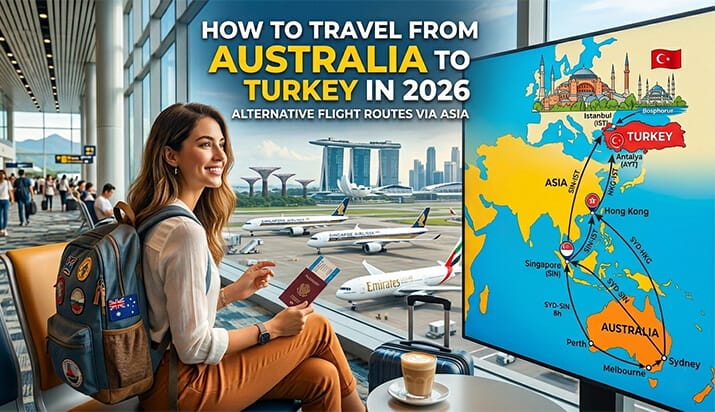
If you are an Australian patient planning to travel to Turkey for cosmetic or plastic surgery, you have probably been watching the news with growing concern. The ongoing military conflict involving Iran, Israel, and the United States — which escalated on 28 February 2026 — has caused widespread disruption across the Middle East, closing major aviation hubs like Dubai, Doha, and Abu Dhabi that Australians have traditionally used as transit points.
Here is the good news: Turkey is not involved in this conflict, Istanbul Airport is fully operational, and you can still fly from Australia to Istanbul — you just need a different route. Instead of the Gulf, you fly through Asia. In many ways, this is not even a new concept. Turkish Airlines has been operating flights from Australia to Istanbul via Singapore and Kuala Lumpur since 2024.
This article provides a complete, up-to-date guide on how Australian patients can safely reach Turkey for their planned procedures using alternative Asian transit routes. We cover which airlines are flying, which hubs are open, what to expect in terms of travel times and costs, and why Istanbul remains a perfectly safe destination for medical tourism.
Why Gulf Routes Are Currently Unavailable
Before the conflict, the vast majority of Australian travellers heading to Europe or Turkey would transit through one of the three major Gulf hubs: Dubai (Emirates), Doha (Qatar Airways), or Abu Dhabi (Etihad Airways). These three carriers alone accounted for nearly 57 per cent of all passenger traffic between Europe and Australasia.
Since 28 February 2026, when US-Israeli military operations against Iran began, the situation across the Gulf region has changed dramatically.
The Australian Government’s Smartraveller advisory is clear: do not travel to or transit through Bahrain, Iran, Iraq, Israel, Kuwait, Lebanon, Palestine, Qatar, Syria, the UAE, or Yemen. This advisory applies even if you do not plan to leave the airport during a layover.
This means the traditional Gulf transit routes that most Australians relied upon are currently off the table. But it does not mean you cannot reach Turkey. It simply means you take a different path.
Is Turkey Safe to Visit in 2026?
This is the most common question we hear from our Australian patients, and the answer is a clear yes — with important geographic nuance.
Turkey is a massive country that straddles Europe and Asia. Istanbul, where most international patients arrive for cosmetic surgery, is located in the far northwest of the country, on the European side of the Bosphorus. The distance between Istanbul and the Iranian border is over 2,000 kilometres. To put that in perspective, Istanbul is closer to Vienna, Rome, and Athens than it is to any conflict zone.
What the official advisories say
The US State Department maintains Turkey at Level 2: Exercise Increased Caution for the main tourist and urban areas, including Istanbul, Antalya, and Cappadocia. The elevated warnings apply specifically to southeastern Turkey near the Syrian and Iraqi borders — areas that are nowhere near Istanbul or the medical tourism circuit.
The UK Foreign Office, the Australian government, and the EU’s travel advisories all confirm the same picture: Turkey’s primary tourist and commercial hubs are operating normally. Flights from Europe, Asia, and the Americas continue to arrive at Istanbul Airport daily. Hotels, hospitals, museums, and public transport are all functioning without disruption.
On the ground in Istanbul
Istanbul Airport (IST) is the second-busiest airport in Europe, handling over 80 million passengers in 2024. It remains fully operational 24/7. Turkish Airlines — the world’s airline serving the most countries — has only cancelled flights to select Middle Eastern destinations. All domestic flights and international flights from Europe, Asia, Africa, and the Americas continue as scheduled.
Tourism authorities in Turkey have been proactive in communicating that the country is open for business. The Turkey Tourism Promotion and Development Agency (TGA) has confirmed that flights are running, hotels are welcoming guests, and all major tourist attractions remain open. Daily life in Istanbul continues as normal.
Alternative Flight Routes: Australia to Istanbul via Asia
The good news for Australian travellers is that Southeast Asia offers multiple well-established transit options that completely bypass the Middle East. These routes are not emergency workarounds — many of them are longstanding commercial services that have simply become more prominent since the Gulf disruptions began.
Route 1: Via Singapore (Changi Airport)
Singapore has emerged as the most reliable alternative hub for Australians heading to Turkey and Europe. Changi Airport is world-class, transfers are efficient, and multiple carriers operate on this corridor.
How it works:
- Fly from Sydney, Melbourne, Brisbane, or Perth to Singapore on Qantas, Singapore Airlines, Jetstar, or Scoot.
- Connect in Singapore to a flight to Istanbul on Turkish Airlines (which operates Istanbul–Singapore–Melbourne and Istanbul–Kuala Lumpur–Sydney services) or Singapore Airlines to a European gateway, then onward to Istanbul.
Key airlines:
- Turkish Airlines: Operates Melbourne–Singapore–Istanbul and Sydney–Kuala Lumpur–Istanbul. This is effectively a one-stop flight to Istanbul on a single ticket, with the same aircraft and flight number. These services have been running since 2024.
- Singapore Airlines: Multiple daily flights from Australian cities to Singapore, with connections to Istanbul.
- Qantas: Confirmed that its Singapore services are unaffected by the Middle East conflict. QF1 (Sydney–Singapore–London) continues to operate normally.
- British Airways: Operates London–Singapore–Sydney with fifth freedom traffic rights — you can fly the Singapore–London leg and connect to Istanbul from London.
Travel time: Approximately 18–22 hours total, depending on layover duration.
Route 2: Via Kuala Lumpur (KLIA)
Kuala Lumpur International Airport has capitalised on the current disruptions and has become a central hub for rerouted international flights. It is ranked as the world’s top low-cost carrier hub in 2026, and its strategic location between Southeast Asia and Australasia makes it an excellent transit point.
How it works:
- Fly from Sydney, Melbourne, or Perth to Kuala Lumpur on Malaysia Airlines, AirAsia X, or Qantas.
- Connect to Istanbul on Turkish Airlines (which operates the Istanbul–KL–Sydney route) or AirAsia X (which launched a Kuala Lumpur–Istanbul route with four weekly flights).
Key airlines:
- Turkish Airlines: The Istanbul–Kuala Lumpur–Sydney service stops in KL in both directions.
- AirAsia X: Launched KL–Istanbul in 2026 with competitive fares, making this an attractive budget option.
- Malaysia Airlines: Part of the oneworld alliance, meaning Qantas passengers can earn and redeem points and access oneworld lounges.
Travel time: Approximately 19–23 hours total. Fares via KL tend to be cheaper than Singapore, especially in economy class.
Route 3: Via Bangkok (Suvarnabhumi Airport)
Bangkok is another strong option, particularly with Finnair launching a Helsinki–Bangkok–Melbourne service in 2026 with fifth freedom traffic rights.
How it works:
- Fly from Sydney or Melbourne to Bangkok on Thai Airways, Qantas, Jetstar, or multiple other carriers.
- Connect to Istanbul on Turkish Airlines (which serves Bangkok three times daily in the current schedule) or Thai Airways with a connection through a European gateway.
Key airlines:
- Turkish Airlines: Three daily flights between Istanbul and Bangkok — excellent connection options.
- Thai Airways: Operates Bangkok to European cities with onward connections to Istanbul.
- Finnair: Helsinki–Bangkok–Melbourne is a new 2026 route; you can fly the Bangkok–Helsinki leg and connect to Istanbul.
- British Airways: Added extra Bangkok services in response to the Middle East crisis.
Travel time: Approximately 20–24 hours total.
Route 4: Via Hong Kong or Seoul
For travellers seeking additional options, both Hong Kong (Cathay Pacific) and Seoul Incheon (Korean Air, Asiana Airlines) offer connections to Istanbul via their respective European networks. Travel times are comparable to Bangkok at around 20–24 hours, and both airports offer excellent transfer facilities.
What to Expect: Travel Times, Costs, and Practical Tips
Travel times
The traditional Gulf route from Australia to Istanbul typically took 18–20 hours including a transit stop. The Asian alternatives add approximately 2–4 hours to the total journey, depending on the hub and layover time. A typical journey via Singapore or KL will take 18–23 hours, which is very comparable to what you were used to.
Airfares
Airfares on Asia–Europe and Australia–Europe routes have increased by approximately 20–30 per cent since the conflict began, due to longer flight paths, higher fuel costs, and increased demand on alternative routes. That said, fares vary significantly by airline, booking lead time, and class of travel. Budget carriers like AirAsia X on the KL–Istanbul route can offer substantially lower fares compared to full-service airlines.
Our recommendation: Book 2–4 months ahead for the best availability and pricing. Use Google Flights or Skyscanner to compare options across all Asian hubs.
Practical tips for Australian patients travelling to Turkey
- Book a single-ticket itinerary where possible. If your connecting flights are on the same ticket (e.g., Turkish Airlines Melbourne–Singapore–Istanbul), the airline is responsible for rebooking you if a connection is missed. Separate tickets do not offer this protection.
- Allow generous layover time. With increased traffic through Asian hubs, aim for at least 2–3 hours for international connections. Changi Airport and KLIA are both efficient, but longer layovers reduce stress, especially before surgery.
- Check your visa requirements. Australian passport holders can enter Turkey visa-free for up to 90 days for tourism or medical purposes. No visa is required for transit through Singapore, Malaysia, or Thailand if you are remaining within the airport.
- Carry all medical documentation. Bring your consultation records, surgical plan, and surgeon’s contact details. Some patients find it helpful to carry a letter from their surgeon confirming the purpose of travel.
- Purchase comprehensive travel insurance. Ensure your policy covers medical tourism and any potential complications. Standard travel insurance policies remain valid for Turkey, as Western travel advisories have not issued a blanket “do not travel” warning for Istanbul or the western/central regions.
- Consider a stopover. If the longer journey feels daunting, build in a one-night stopover in Singapore, Kuala Lumpur, or Bangkok. This can turn the transit into a mini-holiday and helps you arrive in Istanbul rested and ready for your consultation.
Why Australian Patients Continue to Choose Turkey for Plastic Surgery
Turkey remains one of the world’s top destinations for cosmetic and plastic surgery, and the current regional conflict has done nothing to change the quality of medical care available in Istanbul. The fundamentals that make Turkey attractive to Australian patients remain firmly in place.
Istanbul’s major hospitals and clinics are JCI-accredited, equipped with modern technology, and staffed by surgeons who have completed rigorous training programmes — typically a six-and-a-half-year residency after medical school, followed by board certification through the Turkish Society of Plastic, Reconstructive and Aesthetic Surgery. The Republic of Turkey’s Ministry of Health regulates all clinics and hospitals to strict standards.
For Australian patients, the cost advantage is significant. Procedures in Turkey typically cost 40–60 per cent less than equivalent procedures in Australia, even when accounting for flights and accommodation. This price difference is driven by lower operating costs — not lower quality. Istanbul’s top surgeons perform high volumes of procedures, which translates to deep expertise, particularly in popular areas like rhinoplasty, body contouring, breast surgery, and hair transplants.
The patient experience is also streamlined. Many Istanbul practices offer comprehensive medical tourism packages that include airport transfers, hotel accommodation, pre-operative consultations, the procedure itself, and post-operative follow-up — all coordinated end-to-end.
Frequently Asked Questions
Can I still fly from Australia to Turkey right now?
Yes. You cannot transit through the Gulf (Dubai, Doha, Abu Dhabi), but you can fly to Istanbul via Asian hubs such as Singapore, Kuala Lumpur, and Bangkok. Turkish Airlines, Singapore Airlines, Malaysia Airlines, AirAsia X, and others operate these routes regularly.
Is Istanbul Airport open?
Yes. Istanbul Airport (IST) is fully operational 24/7. It is the second-busiest airport in Europe and continues to handle scheduled international flights from Asia, Europe, Africa, and the Americas. Turkish Airlines has only suspended flights to select Middle Eastern destinations — not to Asia, Europe, or the rest of the world.
Is Turkey safe for medical tourism in 2026?
Yes, for the vast majority of the country. Istanbul, where most international patients have their procedures, is located in the far northwest of Turkey — over 2,000 km from the Iranian border and over 1,100 km from Israel. Official travel advisories from Australia, the US, and the UK all confirm that Istanbul and western Turkey remain at normal or low-risk advisory levels. Tourism, healthcare, and daily life continue without disruption.
Which is the best route from Australia to Istanbul right now?
For most Australian patients, the Singapore route offers the best balance of convenience, frequency, and reliability. Turkish Airlines operates direct services from both Melbourne and Sydney to Istanbul via Singapore and Kuala Lumpur respectively. Singapore Airlines also provides excellent connectivity through Changi Airport.
Does your clinic help patients with flight bookings and travel arrangements?
Yes. We understand that navigating alternative flight routes can feel overwhelming, especially when the usual travel options have changed. Our international patient coordination team is here to assist you throughout the entire process — from recommending the most convenient transit routes and airlines to helping you coordinate your arrival dates with your surgical schedule. We can also arrange your airport pickup in Istanbul, hotel accommodation, and all transfers between your hotel, the clinic, and the hospital. Our goal is to make sure the travel side of your journey is as smooth and stress-free as the medical side, so you can focus entirely on your procedure and recovery.
How long does it take to fly from Australia to Istanbul via Asia?
Total travel time is approximately 18–23 hours, depending on the transit hub and layover duration. This is comparable to the traditional Gulf route, which typically took 18–20 hours including a stop in Dubai or Doha.
Are flights from Australia to Turkey more expensive now?
Fares have increased by roughly 20–30 per cent on average due to increased demand on alternative routes and higher fuel costs. However, budget options exist — AirAsia X’s Kuala Lumpur–Istanbul service offers competitive pricing, and booking 2–4 months in advance helps secure better rates.
Do I need a visa for Turkey as an Australian citizen?
No. Australian passport holders can enter Turkey visa-free for up to 90 days for tourism or medical travel. No pre-arranged visa is needed. Your passport must be valid for at least 150 days from your date of entry into Turkey.
What about transit visas for Singapore, Malaysia, or Thailand?
Australian passport holders do not require a visa for short transits (under 24–96 hours, depending on the country) through Singapore, Malaysia, or Thailand. If you remain within the international transit area of the airport, no visa is needed at all.
Will Turkish Airlines have direct flights from Australia to Istanbul?
Turkish Airlines is planning to launch non-stop flights between Sydney/Melbourne and Istanbul by late 2026 or early 2027, using ultra-long-range Airbus A350 aircraft. Once operational, these flights will eliminate the need for any transit stop and reduce travel time to approximately 16–17 hours.
Is it safe to fly over Turkey’s airspace?
Yes. Turkish airspace is fully open and unrestricted. Turkey is a NATO member and is not a participant in the Iran–Israel–US conflict. Istanbul Airport continues to operate normally, and Turkish aviation authorities have confirmed that air traffic services are functioning safely.
Can I book my plastic surgery consultation before confirming my flights?
Absolutely. We encourage patients to begin their consultation process via video call or online communication well before booking flights. This allows us to develop a surgical plan, answer your questions, and give you a realistic timeline — so you can book your flights with confidence once you are ready to proceed.
What happens if my flight is disrupted due to the conflict?
If you are booked on a single-ticket itinerary with a carrier like Turkish Airlines, the airline is responsible for rebooking you at no extra cost if a disruption occurs. Turkish Airlines has had a flexible rebooking and refund policy in place since the conflict began. If you book separate tickets for each leg, you bear the risk of missed connections yourself — so we strongly recommend single-ticket bookings.